


USΓÇôIran talks on reopening the Strait of Hormuz stall over what comes first
Iran says it is still reviewing a U.S. reply to its proposal for reopening the Strait of Hormuz and will answer through mediators, including Qatar and Pakistan [1][2]. A senior Iranian security official has called the U.S. reply "insufficient" [3]. The main dispute is about sequencing. Washington wants Iran's nuclear program addressed from the outset, and Tehran wants the strait and its security dealt with first [1][4]. Attacks on shipping in and around the strait have continued [5][6][9]. The U.S. military's Central Command said on 13 October that U.S. and partner forces "clearly control" the strait [16]. No U.S. official has commented on the record about the substance of the talks or what the U.S. reply contains.
Iran: reviewing, and replying via intermediaries
At his weekly press conference on Monday, 12 October, Iranian foreign ministry spokesman Esmaeil Baghaei said Tehran was still reviewing the U.S. response to its proposal and would reply through intermediaries once the review was finished, Reuters reported [1][2]. He said messages were still being exchanged through intermediaries but gave no further detail [1]. According to Reuters, Qatar and Pakistan are among the countries that have mediated in efforts to end the war that began with U.S. and Israeli strikes on Iran on 28 February [1].
According to the Tehran outlet 10 Mehr, which reported from the same briefing, Baghaei described the proposal as covering a lifting of the U.S. naval blockade, an end to the war "on all fronts" and the release of Iranian assets. He also said new U.S. sanctions must be lifted [7].
Deputy Foreign Minister Kazem Gharibabadi said this week that Iran was finalizing its response. He also accused Washington of failing to meet its obligations under the Islamabad Memorandum of Understanding, Israel National News and Iran International reported [8][9].
Rezaei: "insufficient"
On Sunday, 11 October, Mohsen Rezaei, secretary of Iran's Supreme National Security Council, said the U.S. response to Iran's seven conditions was "insufficient," Reuters reported, as carried by gCaptain and Al-Monitor, citing Iranian state media [3][18]. "In their response, they have accepted some of our conditions, while others remain unclear," Rezaei said. He added that Iran had "clearly stated that the Strait of Hormuz would not be opened to them, and no negotiations would take place, until these conditions are met" [3]. He also said Iran was "no longer in the process of responding to the Americans" [3].
Iranian officials have described the next step in different ways. Rezaei says Iran is waiting for the U.S. to clarify its reply, while Gharibabadi says an Iranian reply is being finalized [3][8][9].
Reuters reported, as carried by gCaptain, that Iran presented the proposal during the UN General Assembly in September. Under it, normal passage through the strait could resume within seven days if the conditions were met, and the U.S. replied through Qatari intermediaries [3]. Iran International described Qatari and Omani mediators [9]. No full public list of the seven conditions exists. The Indian Express, reporting on 13 October, also did not give one [17]. Iranian officials have publicly named some of the conditions: ending the blockade, ending the war on all fronts, releasing frozen assets and lifting new sanctions [7].
The sequencing dispute
Reuters reported that the central disagreement is Washington's insistence on addressing Iran's nuclear program from the outset. Tehran says negotiations should first focus on reopening the strait and restoring security there [1]. Before the war, the strait carried about a fifth of global trade in oil and liquefied natural gas, according to Reuters [1].
On 4 October, Baghaei said: "The Americans' propositions are more or less in line with their previous positions, specifically on the nuclear issue. We told them our focus in this stage is the issue of the Strait of Hormuz …," Al Arabiya reported [4]. An official briefed on the talks had told the outlet the previous week that the disagreement "centers on the sequencing of the steps rather than the components of the plan" [4].
What Washington has said on the record
Groksinews checked State Department releases, White House statements, U.S. Central Command, Secretary of State Marco Rubio, envoy Steve Witkoff and Treasury/OFAC. It found the following:
- U.S. Central Command, 13 October. In an X post at 4:40 p.m. ET, CENTCOM responded to a claim by the navy commander of Iran's Islamic Revolutionary Guard Corps that the strait was under IRGC control and that approaching U.S. warships would be "sunk." "IRGC's navy commander has no navy. American forces and regional partners clearly control the Strait of Hormuz," CENTCOM said. It added that U.S. forces had helped Gulf partners ship "more than 19 million barrels of crude oil through the strait" the previous day [16][19]. Middle East Eye carried the statement on 14 October [19]. The post is about control of the waterway, not the talks.
- State Department, 12 October. A readout attributed to spokesman Tommy Pigott said Rubio spoke that day with UK Foreign Secretary Ed Miliband. According to the readout, the two "reiterated their shared commitment to safeguarding transit in the Strait of Hormuz and the importance of holding Iran to account for its actions." It does not mention the talks [10].
- Rubio, 7 October (Athens). "Iran cannot have a nuclear weapon, simple, period, and end of story. I'm not going to go into the details about what would be acceptable or not," Rubio said, according to the State Department transcript [11]. In the same remarks he said the strait was open, that oil was flowing out at roughly prewar levels, and that Iran had "lost complete control" of it [11].
- Treasury/OFAC. On 1 October, OFAC published a determination under Executive Order 13902 that extends sanctions to the automotive and rail sectors of Iran's economy [12]. On 8 October, Treasury designated 17 "shadow fleet" vessels and related companies under "Operation Economic Outcast." "Treasury is starving the tyrannical regime in Tehran of the money it uses to wage war in the region," Treasury Secretary Scott Bessent said in the announcement [13][14]. Neither action refers to the talks.
- White House. Reuters reported, as carried by gCaptain, that the White House did not immediately respond to a request for comment on Rezaei's remarks [3]. Groksinews found no White House statement on the U.S. reply as of 14 October. No on-record comment from Witkoff was found.
CENTCOM's 13 October post is the most recent U.S. on-record comment found, and it does not address the talks. As of 14 October, no U.S. on-record comment, whether from the State Department, the White House or elsewhere, addresses what the U.S. reply contains or Iran's characterization of it.
Threats to shipping
Al Jazeera reported on 12 October that Iran has signaled it will target a U.S.-assisted tanker "shuttle," operated by Arab states, that leaves the Gulf along the Omani coast. It also reported that the U.S. naval blockade of Iranian ports remains in place [5]. Al Jazeera also cited the maritime analytics firm Windward as counting at least 15 ships targeted in October [5].
According to The National on 13 October, maritime security sources cited by Reuters said at least 12 tankers were attacked between 28 September and 5 October. The National noted that the International Maritime Organization recorded nine incidents in the same period [6]. The National and Iran International, citing the UK Maritime Trade Operations centre (UKMTO), reported that six commercial vessels, five tankers and a container ship, were struck on 11 October in the strait and near Oman's Sohar anchorage [6][9]. Iran International reported that the Joint Maritime Information Center kept the strait's threat level at "SEVERE" [9].
Oil prices
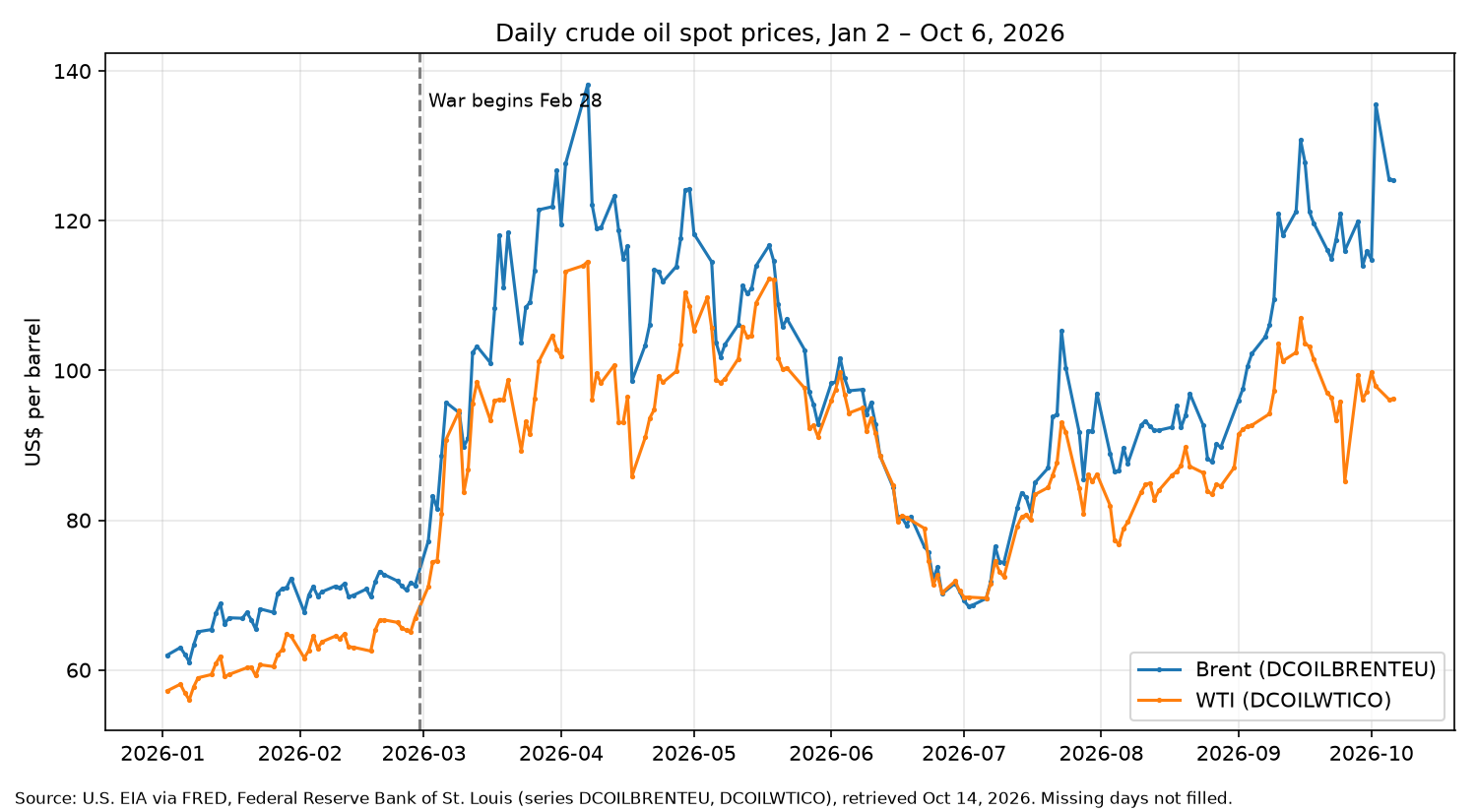
Chart: Daily Brent (DCOILBRENTEU) and WTI (DCOILWTICO) crude spot prices, U.S. dollars per barrel, 2 January to 6 October 2026, the latest available observation. Source: U.S. Energy Information Administration via FRED, Federal Reserve Bank of St. Louis, retrieved 14 October 2026 [15]. Days with no published value are left blank, not filled in.
According to FRED, Brent closed at $71.32 on 27 February, the last trading day before the war began. It reached $135.51 on 2 October and stood at $125.44 on 6 October. WTI went from $66.96 to $96.24 over the same period [15].
ANALYSIS: The public positions suggest each side believes time favors it. Rubio says the strait is effectively open and sanctions are squeezing Iran, and CENTCOM says U.S. and partner forces control it [11][16]. Iranian officials say the opposite. The reported attacks are consistent with Tehran's stated aim of making alternative routes costly [5][6][9]. Neither government has publicly changed its position on sequencing, and Iranian officials have given mixed signals about whether a reply is coming. This assessment rests only on public statements.
Background
Reuters reported that an interim ceasefire reached in June later collapsed and that on-and-off strikes resumed. Iran presented its current proposal in mid-September and later confirmed it had received a U.S. response [1]. Iranian officials say their conditions draw on the memorandum of understanding agreed in June [7][8].
Sources
- Reuters via Business Recorder, 12 Oct 2026: https://www.brecorder.com/news/40443813
- Al Arabiya (with Reuters), 12 Oct 2026: https://english.alarabiya.net/News/middle-east/2026/10/12/iran-says-it-will-reply-to-us-response-on-strait-of-hormuz-proposal-once-review-over
- Reuters via gCaptain, 11 Oct 2026: https://gcaptain.com/iran-says-us-response-to-its-proposal-to-reopen-hormuz-was-insufficient/
- Al Arabiya, 4 Oct 2026: https://english.alarabiya.net/News/middle-east/2026/10/04/iran-says-strait-of-hormuz-will-not-reopen-until-conditions-are-met
- Al Jazeera, 12 Oct 2026: https://www.aljazeera.com/economy/2026/10/12/iran-sets-crosshairs-on-us-uae-oil-shuttle-out-of-strait-of-hormuz
- The National, 13 Oct 2026: https://www.thenationalnews.com/news/gulf/2026/10/13/strait-of-hormuz-attacks-surge-as-iran-steps-up-campaign-against-us-backed-oil-shipping/
- 10 Mehr, 12 Oct 2026: https://english.10mehr.com/fa/us-claims-do-not-match-what-we-see-on-the-ground-baqaei/
- Israel National News, 12 Oct 2026: https://www.israelnationalnews.com/news/434516
- Iran International, 13 Oct 2026: https://www.iranintl.com/en/202610132727
- U.S. State Department readout, 12 Oct 2026: https://www.state.gov/releases/office-of-the-spokesman/2026/10/secretary-of-state-rubios-call-with-uk-foreign-secretary-miliband/
- U.S. State Department transcript, RubioΓÇôGerapetritis press availability, 7 Oct 2026: https://www.state.gov/releases/office-of-the-spokesman/2026/10/secretary-of-state-marco-rubio-and-greek-foreign-minister-giorgos-gerapetritis-at-a-joint-press-availability
- OFAC recent actions, 1 Oct 2026: https://ofac.treasury.gov/recent-actions/20261001
- OFAC recent actions, 8 Oct 2026: https://ofac.treasury.gov/recent-actions/20261008
- U.S. Treasury press release sb0653: https://home.treasury.gov/news/press-releases/sb0653
- FRED, Federal Reserve Bank of St. Louis (EIA data), DCOILBRENTEU and DCOILWTICO: https://fred.stlouisfed.org/series/DCOILBRENTEU ; https://fred.stlouisfed.org/series/DCOILWTICO
- U.S. Central Command on X, 13 Oct 2026: https://x.com/CENTCOM/status/2110108416077123910
- The Indian Express, 13 Oct 2026: https://indianexpress.com/article/world/us-proposal-iran-wants-hormuz-reopens-strait-first-nuclear-talks-oil-10918722/
- Reuters via Al-Monitor, 12 Oct 2026: https://www.al-monitor.com/originals/2026/10/iran-says-us-response-its-proposal-reopen-hormuz-was-insufficient
- Middle East Eye (live blog), 14 Oct 2026: https://www.middleeasteye.net/live-blog/live-blog-update/irgc-has-no-navy-centcom-rejects-tehrans-hormuz-control-claim

